 EMERGING TECH
EMERGING TECH
EMERGING TECH






EMERGING TECH

Before rising to data center prominence, Nvidia Corp. focused primarily on making graphics cards for the high-powered desktops favored by videogame enthusiasts, a market that remains an important revenue source for the chipmaker.
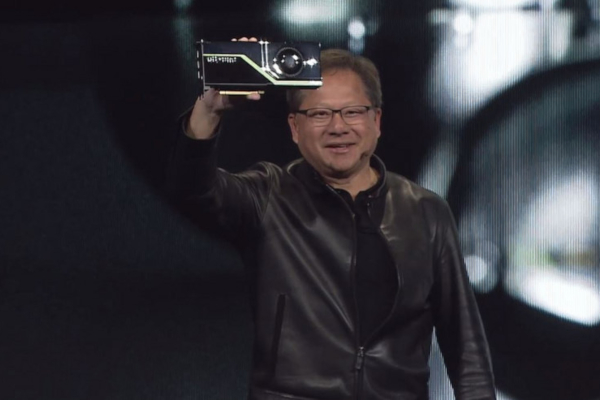
At a gaming event in Germany today, Nvidia Chief Executive Officer Jensen Huang followed through on a veiled promise during Nvidia’s earnings report late last week by introducing the RTX 2000 (pictured), a new series of graphics processing units based on the company’s just-introduced Turing architecture. Turing is touted as six times faster than the preceding Pascal design.
The new RX 2000 GPU chips all feature a number of common building blocks derived from the architecture. Among them are so-called RT Cores designed to perform real-time ray tracing, a graphics rendering method that has until now been limited to nonreal-time uses such as producing visual effects for movies. Marvel Entertainment LLC and Pixar are among the studios known to employ the technique.
Nvidia said the RX 2000 chips are the first consumer GPUs on the market with enough processing power for real-time ray tracing. This means that it can be applied to improve game graphics as they’re rendered on the user’s screen. Moreover, the company has equipped the chips with another specialized core type that draws on its experience in building enterprise-grade artificial intelligence processors to further improve visual fidelity.
The RX 2000 features so-called Turing Tensor Cores that, according to Nvidia, can provide up to 110 teraflops of processing power. That’s 10 times the performance offered by the company’s previous top-end GeForce 1080 Ti gaming CPU. Nvidia said the Turing Tensor Core runs AI models capable of generating new pixels to add more detail to games.
Consumers looking to take advantage of the RX 2000 series’ capabilities will have a choice of three GPU models. The flagship is the RTX 2080 Ti, which will start at $999 and features 4,352 processing cores with a base clock speed of 1,350 megahertz that can be increased to 1,635 Mhz. The cores are paired with 8 gigabytes of high-speed GDDR6 memory.
Nvidia will sell a more affordable version of the chip, the RTX 2080, that is set to start at $799 and offers 8Gb of GDD46 memory with 2,966 cores. Capping off the lineup is the RTX 2070, the cheapest of the trio at a $499 starting price.
Support our mission to keep content open and free by engaging with theCUBE community. Join theCUBE’s Alumni Trust Network, where technology leaders connect, share intelligence and create opportunities.
Founded by tech visionaries John Furrier and Dave Vellante, SiliconANGLE Media has built a dynamic ecosystem of industry-leading digital media brands that reach 15+ million elite tech professionals. Our new proprietary theCUBE AI Video Cloud is breaking ground in audience interaction, leveraging theCUBEai.com neural network to help technology companies make data-driven decisions and stay at the forefront of industry conversations.





