 INFRA
INFRA
INFRA
INFRA







INFRA

Multicloud architectures are putting strain on storage infrastructure to be everywhere all the time. The logistics of moving data around remain frustrating; even if companies can pay the cost of transit, arrival times may not be worth it. Is there a storage array to help data make it on time to disparate locations on-premises, in the cloud, and at the edge of computing networks?
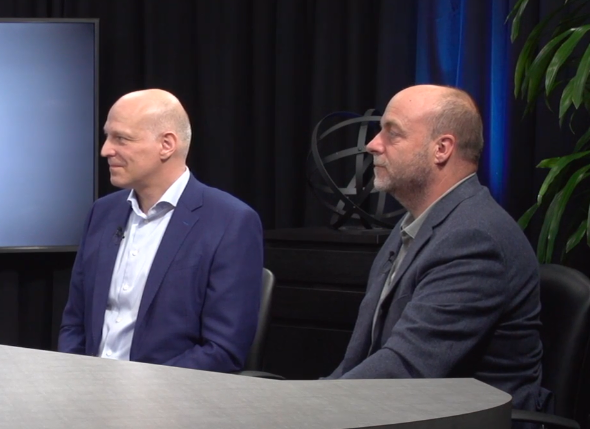
While many companies long for a single, perfect cloud in which to run all workloads, they likely won’t get it for some time, according to Guy Churchward (pictured, right), executive chairman of Datera Inc. The forecast calls for a mishmash of infrastructure and internet of things edge devices that will force companies into a hybrid operating model, he explained. This will likely be the case for about the next five to seven years.
Modern applications demand that data from all of these disparate places show up on time for analytics, etc.
“The whole concept is to say, how do I utilize data no matter where it is into a fabric or a mesh?” Churchward said. The storage industry has historically tried to “own” the data in this or that silo. However, it’s necessary now to store, manage and orchestrate data at a software-defined layer that spans all locations, he added.
Churchward and Marc Fleischmann (pictured, left), founder and chief executive officer of Datera, spoke with Peter Burris (@plburris), host of theCUBE, SiliconANGLE Media’s mobile livestreaming studio, at theCUBE’s studio in Palo Alto, California. They discussed Datera’s approach to storage and data orchestration for multicloud.
Datera doesn’t sell traditional storage arrays — they’re server-based, software-defined storage products with data orchestration. That’s a basic description of Datera’s data services platform running on x86-based nodes or pre-configured Datera appliances.
The applications themselves manage the storage resources, according to Fleischmann. More specifically, machine-learning technology understands the requirements of individual applications and manages the physical resources and server capabilities underneath them.
“We’ve engineered the whole data path down to the physical devices ourselves,” Fleischmann said. (In fact, Datera contributed a significant part of the Linux data path itself.) This achieves performance levels along the lines of millions of input/output operations per second across the data center with latency under 200 microseconds. It all happens on standard servers over standard protocols — no fancy hardware is required.
“That’s the true promise of software defined storage,” Fleischmann stated.
For part 1 of Burris’ conversation with Guy Churchward and Marc Fleischmann, watch the complete video below:
Datera gives users “the ability to actually serve primary workloads across multiple protocols but to serve them location-dependent wherever you like because we orchestrate the data to those places,” Churchward said.
Datera’s data orchestration can be compared to Kubernetes, according to Fleischmann. The open-source platform orchestrates containers (a virtualized method for running distributed applications). “We are to data what Kubernetes is to compute across a number of operating environments,” he said.
The power of Kubernetes is that it abstracts the infrastructure to a level where it’s delivered continuously to the application. Datera does same thing for data — the storage, management and life-cycle of data, Fleishmann explained.
“You have certain access requirements — protocols, authentication, security; you have certain performance requirements; you have certain reliability requirements; you articulate them simply in similar service-level objectives. Datera does all the actual implementation automatically across the data center,” he added.
When data delivery, automation and orchestration are frictionless, it opens up new classes of applications, Fleischmann explained.
Data at the ready is crucial for modern analytics applications, according to Churchward. “If your analytics don’t run as fast as your company’s competitive space, you’re behind,” he said.
Datera counts a top travel-fare aggregator site as a customer.
Server-based storage is already larger than traditional array-based storage, growing at five times year over year, according to Fleischmann. Datera is growing at 240 percent CAGR.
For part 2 of Burris’ conversation with Guy Churchward and Marc Fleischmann, watch the complete video below:
Support our mission to keep content open and free by engaging with theCUBE community. Join theCUBE’s Alumni Trust Network, where technology leaders connect, share intelligence and create opportunities.
Founded by tech visionaries John Furrier and Dave Vellante, SiliconANGLE Media has built a dynamic ecosystem of industry-leading digital media brands that reach 15+ million elite tech professionals. Our new proprietary theCUBE AI Video Cloud is breaking ground in audience interaction, leveraging theCUBEai.com neural network to help technology companies make data-driven decisions and stay at the forefront of industry conversations.





