 BLOCKCHAIN
BLOCKCHAIN
BLOCKCHAIN







BLOCKCHAIN

One year ago at re:Invent, Amazon Web Services Inc. executives appeared to be in no major rush to roll out new products for developers in the blockchain space. That changed in a hurry last month as AWS introduced two new services designed to make the blockchain easier to use and scale up to support applications.
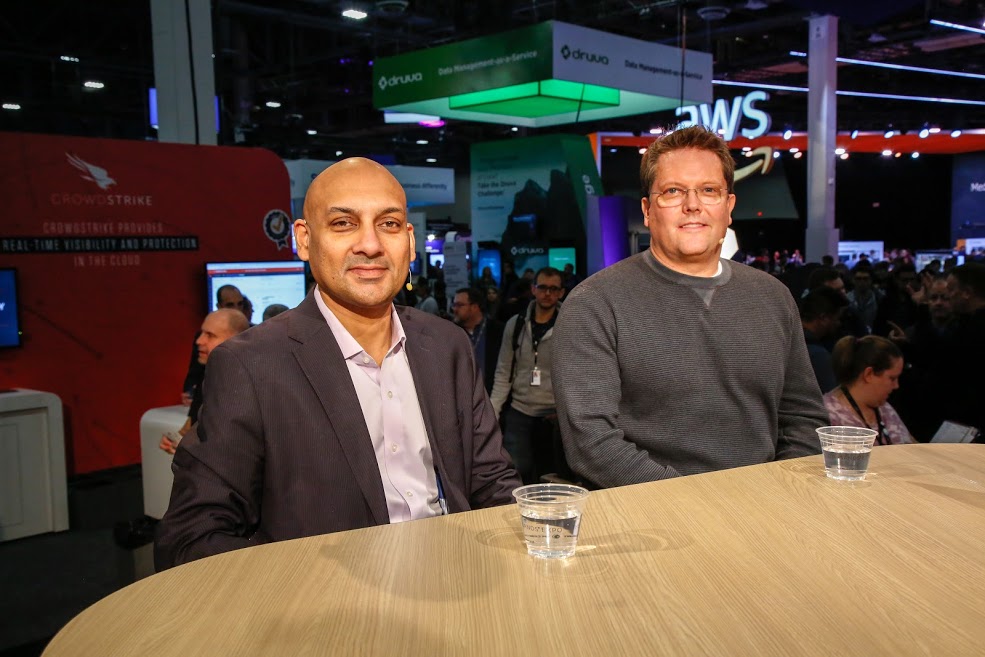
“In scenarios where customers really wanted the decentralized trust and smart contracts, that’s where blockchain frameworks like Hyperledger Fabric and Ethereum play a role,” said Rahul Pathak (pictured, left), general manager of big data, data lakes and blockchain at AWS. “But they are just super complicated to use, and that’s why we built Amazon Managed Blockchain — to make it easier to stand up, scale, and monitor these networks so customers can focus on building applications.”
Pathak spoke with John Furrier (@furrier) and Dave Vellante (@dvellante), co-hosts of theCUBE, SiliconANGLE Media’s mobile livestreaming studio, during AWS re:Invent in Las Vegas. He was joined by Shawn Bice (pictured, right), vice president of non-relational databases at AWS, and they discussed the introduction of tools designed to make the blockchain easier to use and a new way to store and analyze information in a data lake. (* Disclosure below.)
Along with Managed Blockchain, AWS also rolled out the Quantum Ledger Database, or QLDB, designed to provide a transparent, immutable and cryptographically verifiable transaction log. The database can track every application data change over time and ensure that transactions remain permanent.
“Once that transaction is written to a journal, it cannot be changed at all,” Bice explained. “If you look at the use cases, in particular, the centralized trust scenario, QLDB does exactly that.”
Immutable transactions mean the accumulation of significant amounts of data, so AWS has also created a new tool called Lake Formation to make it easier for users to set up a secure data lake. The repository will store data in its original form and prepare it for analytics too.
“With Lake Formation what we are trying to do is make it super easy to set up data lakes,” Pathak said. “Now customers can just use Lake Formation, set up data lakes, curate their data, protect it in a single place, and then have those policies enforced across all of the analytics and services that they might use.”
Watch the complete video interview below, and be sure to check out more of SiliconANGLE’s and theCUBE’s coverage of AWS re:Invent. (* Disclosure: Amazon Web Services Inc. sponsored this segment of theCUBE. Neither AWS nor other sponsors have editorial control over content on theCUBE or SiliconANGLE.)
Support our mission to keep content open and free by engaging with theCUBE community. Join theCUBE’s Alumni Trust Network, where technology leaders connect, share intelligence and create opportunities.
Founded by tech visionaries John Furrier and Dave Vellante, SiliconANGLE Media has built a dynamic ecosystem of industry-leading digital media brands that reach 15+ million elite tech professionals. Our new proprietary theCUBE AI Video Cloud is breaking ground in audience interaction, leveraging theCUBEai.com neural network to help technology companies make data-driven decisions and stay at the forefront of industry conversations.





