 INFRA
INFRA
INFRA
INFRA







INFRA

Software-defined technologies are often lauded as flexible and customizable, through customer-set policies, etc. Liberally kicking in new application program interfaces can give end users even more options and control.
Cisco Systems Inc. is using APIs to satisfy every single last user of its intent-based networking.
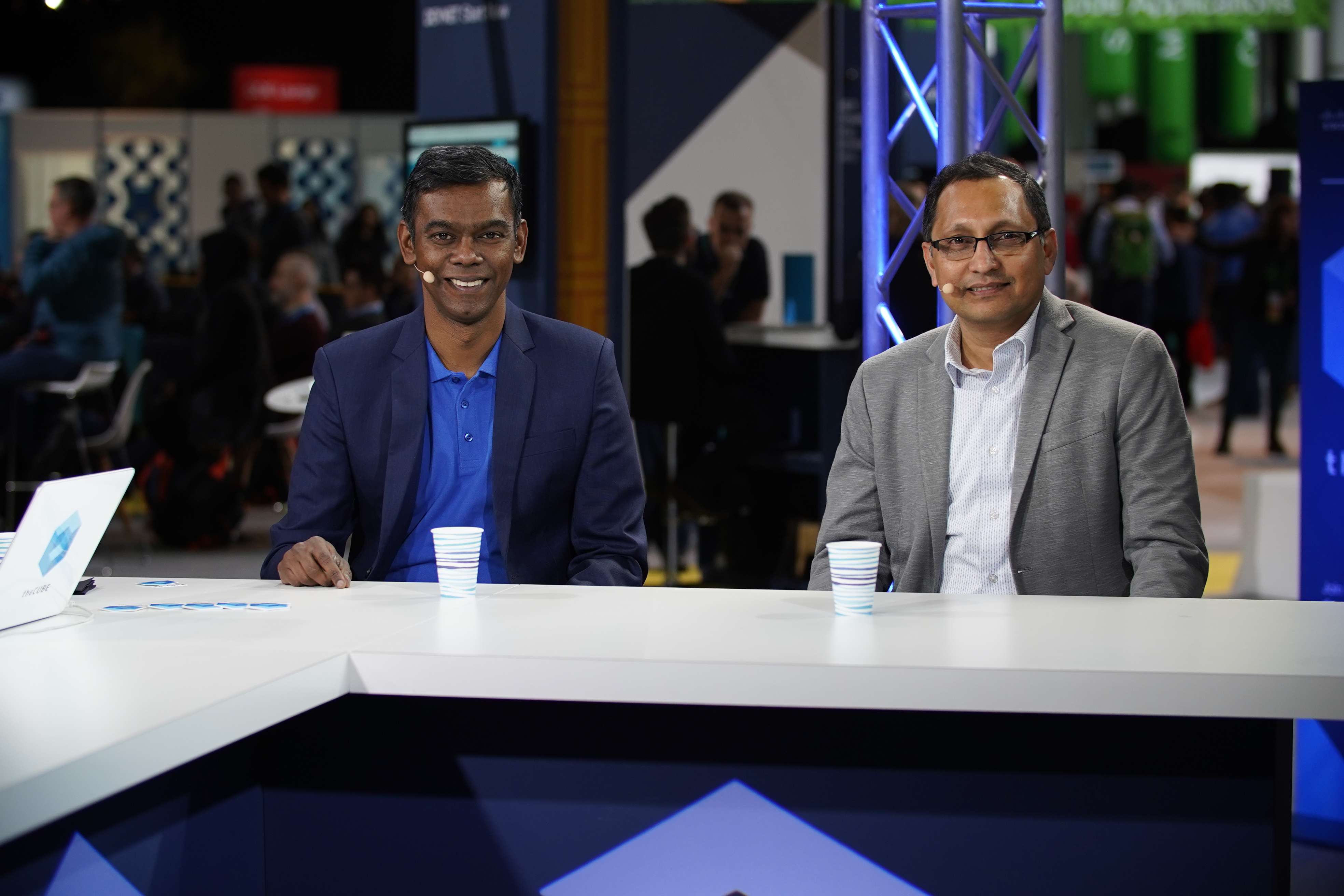
“We we have gone from … a bottom-up way to build a product to a top-down customer-driven, use-case-driven way to build a product,” said Prakash Rajamani (pictured, left), director of product management at Cisco.
The Cisco DNA Center is an an open, extensible management platform for intent-based networking. It provides a centralized dashboard for managing enterprise networks. Several add-ons for customers come in the form of APIs. “Every feature, every capability that we built in the product was built API first before we built a UI around it,” Rajamani said.
APIs have revolutionized the way Cisco develops capabilities, so it can cover more of its user base. The DNA team can quickly serve a problem-solving API to a customer who would have been out of luck in the past.
Rajamani and Ronnie Ray (pictured, right), vice president of product management at Cisco, spoke with John Furrier (@furrier) and Stu Miniman (@stu), co-hosts of theCUBE, SiliconANGLE Media’s mobile livestreaming studio, during the Cisco Live event in Barcelona, Spain. They discussed how API-driven products and development can give customers more say-so then ever. (* Disclosure below.)
Waiting for a badly needed solution to debut as a bona fide feature is frustrating for customers. If the vendor can roll it out sooner as a stripped-down API, why doesn’t it? This is exactly Cisco’s thinking.
“We had a customer who was like, ‘I need this feature now.’ And we were hand-strapped. We had a big backlog,” Rajamani said. “We were able to work with the customer and say, ‘Hey, you can wire these three APIs and you can get what you’re looking for.”
It was a simple solution for both Cisco and the customer.
“The benefit is as you start getting into the 30-percent use case … we provide very granular APIs [and] very business-driven, simplified-intent APIs,” Rajamani said. This satisfies those customers that aren’t perfectly happy with what’s coming out of the box.
Looking ahead, DNA will beyond go beyond APIs into actual workflows, according to Ray.
“There’s a capability that’s coming in the future that’ll also deal with workflows,” he said. “The workflows will be built on something which is machine-built, so there will be a lot of analytics.”
Watch the complete video interview below, and be sure to check out more of SiliconANGLE’s and theCUBE’s coverage of the Cisco Live event. (* Disclosure: Cisco Systems Inc. sponsored this segment of theCUBE. Neither Cisco nor other sponsors have editorial control over content on theCUBE or SiliconANGLE.)
Support our mission to keep content open and free by engaging with theCUBE community. Join theCUBE’s Alumni Trust Network, where technology leaders connect, share intelligence and create opportunities.
Founded by tech visionaries John Furrier and Dave Vellante, SiliconANGLE Media has built a dynamic ecosystem of industry-leading digital media brands that reach 15+ million elite tech professionals. Our new proprietary theCUBE AI Video Cloud is breaking ground in audience interaction, leveraging theCUBEai.com neural network to help technology companies make data-driven decisions and stay at the forefront of industry conversations.





