 CLOUD
CLOUD
CLOUD
CLOUD







CLOUD

The leading image for IBM Corp.’s case study with a banking customer — Nationwide Building Society — is not a teller window, deposit slip, or even an ATM. It’s a digital watch.
That’s because as the United Kingdom-based financial institution sought to reinvent its business processes for the digital age, it could no longer rely solely on assets common to the banking industry for decades. Customers wanted their financial transactions to look and feel like ordering a car or pizza, always available on any device at any time, and the bank had to change its services to reflect this.
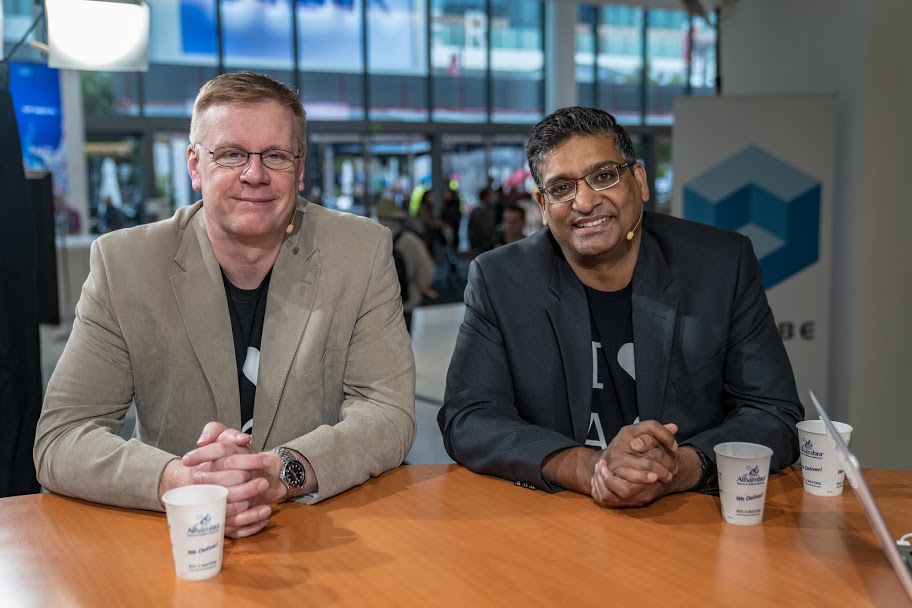
“The approach now is on what the customer is demanding, and their expectation is based on the most recent experience that they had somewhere else, not necessarily with the bank,” said Ashutosh Muni (pictured, right), vice president of applications services at IBM. “So now the co-creation model is coming from the other side of the equation rather than from the asset-out.”
Muni spoke with Stu Miniman (@stu) and John Furrier (@furrier), co-hosts of theCUBE, SiliconANGLE Media’s mobile livestreaming studio, during the IBM Think event in San Francisco. They were joined by Gary Delooze (pictured, left), chief technology officer at Nationwide Building Society, to discuss the bank’s technology strategy and how it’s transcending legacy computing systems. (* Disclosure below.)
In September, Nationwide announced a multi-billion-dollar investment in technology. The elements involved included building out a digital platform that would integrate video and social media while leveraging microservices.
“For us, the key is the smaller the microservices, the more agility we can create,” Delooze explained. “We have 30 to 40 years of legacy technology. We need to transform that technology and build the next generation of digital services alongside that.”
Nationwide has 15 million customers and is a top-three mortgage lender in the U.K. It has channeled its investment to develop next-generation banking applications, including those for facilitating mobile payments using wearables like a digital watch.
“How do we get away from that world where we’re constantly focusing on legacy to start focusing on new technology?” Delooze asked. “It’s bringing in new people with new ideas; it’s changing the way we work.”
Watch the complete video interview below, and be sure to check out more of SiliconANGLE’s and theCUBE’s coverage of the IBM Think event. (* Disclosure: IBM Corp. sponsored this segment of theCUBE. Neither IBM nor other sponsors have editorial control over content on theCUBE or SiliconANGLE.)
Support our mission to keep content open and free by engaging with theCUBE community. Join theCUBE’s Alumni Trust Network, where technology leaders connect, share intelligence and create opportunities.
Founded by tech visionaries John Furrier and Dave Vellante, SiliconANGLE Media has built a dynamic ecosystem of industry-leading digital media brands that reach 15+ million elite tech professionals. Our new proprietary theCUBE AI Video Cloud is breaking ground in audience interaction, leveraging theCUBEai.com neural network to help technology companies make data-driven decisions and stay at the forefront of industry conversations.





