 AI
AI
AI
AI







AI

In a simpler information technology world, operations were confined to what lay inside the four walls of a data center. Instances, servers and middleware all hummed along in a smaller, easier-to-manage environment.
Those days are long gone.
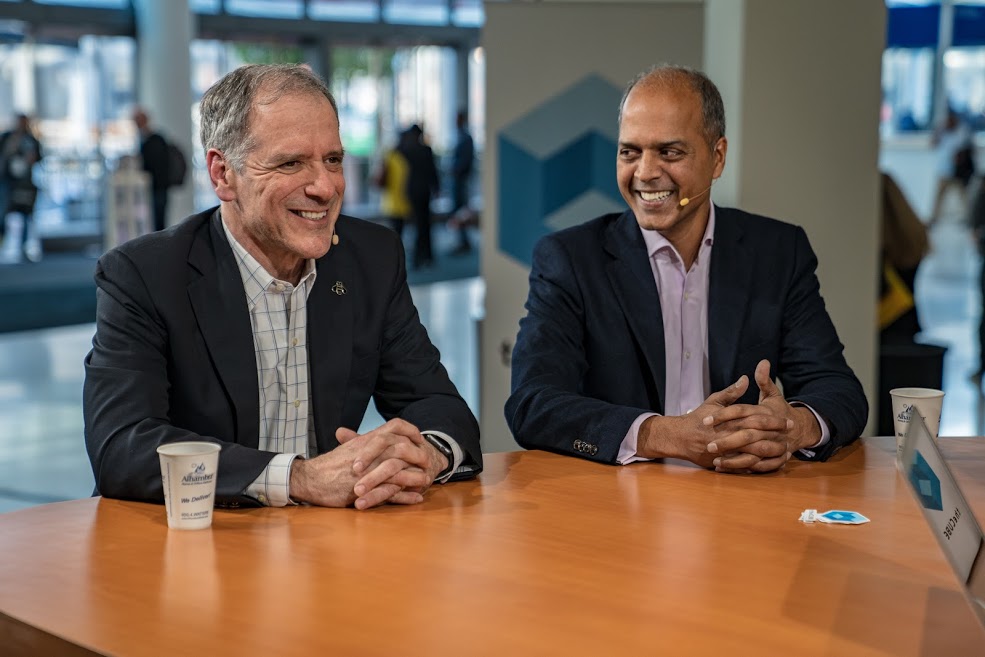
“Now I’ve got my applications running in Salesforce.com offering software as a service. I’ve got three or four infrastructure as a service providers. I still have the legacy that I’ve got to deal with,” said Joe Damassa (pictured, left), vice president of global services at IBM Corp. “The integration problems are just horrendous.”
Damassa spoke with Dave Vellante (@dvellante) and John Furrier (@furrier), co-hosts of theCUBE, SiliconANGLE Media’s mobile livestreaming studio, during the IBM Think event in San Francisco. They were joined by Murali Nemani (pictured, right), chief marketing officer of ScienceLogic Inc., and they discussed IBM’s partnership with ScienceLogic to provide monitoring tools in hybrid environments and the use of automation to derive value from collected data. (* Disclosure below.)
To address the challenges of IT integration, IBM is partnering with ScienceLogic to provide Hybrid IT infrastructure management, a solution that keeps track of workload migrations and compute resources.
“There’s a lot of work to do in terms of getting to that tipping point where workloads are now truly in multicloud or hybrid cloud,” Nemani said. “You need a common, manageable environment that provides visibility across those workloads, so that’s at the heart of what we’re pulling.”
ScienceLogic offers its SL1 Platform to provide an automation engine for AIOps across distributed and cloud architectures. The platform consolidates tools and information into a single operational data lake and enriches that data with contextual insights.
“It’s the breadth of their platform in terms of the different things it can monitor, the depth and ability to go into containers and understand what the applications are doing, and the scale in terms of the types of devices,” Damassa said. “Software is great, but it’s about software that collects the data, analyzes the data, and gives you the insights so you can actually automate and create value.”
Watch the complete video interview below, and be sure to check out more of SiliconANGLE’s and theCUBE’s coverage of the IBM Think event. (* Disclosure: ScienceLogic Inc. sponsored this segment of theCUBE. Neither ScienceLogic nor other sponsors have editorial control over content on theCUBE or SiliconANGLE.)
Support our mission to keep content open and free by engaging with theCUBE community. Join theCUBE’s Alumni Trust Network, where technology leaders connect, share intelligence and create opportunities.
Founded by tech visionaries John Furrier and Dave Vellante, SiliconANGLE Media has built a dynamic ecosystem of industry-leading digital media brands that reach 15+ million elite tech professionals. Our new proprietary theCUBE AI Video Cloud is breaking ground in audience interaction, leveraging theCUBEai.com neural network to help technology companies make data-driven decisions and stay at the forefront of industry conversations.





