






It’s been a year and a half since Dave Donatelli, HP’s Executive Vice President and General Manager of Enterprise Servers, Storage and Networking (ESSN), unveiled HP’s converged infrastructure strategy.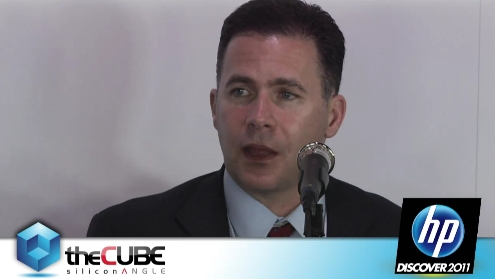
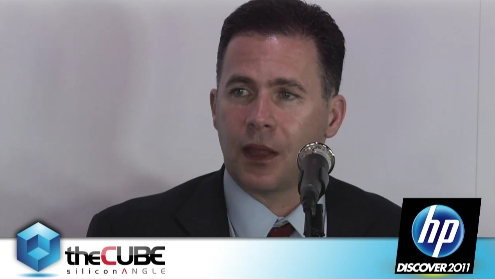
HP’s storage unit has been trying to do its part ever sine, according to Tom Joyce, HP’s Vice President of Marketing for storage.
“We’ve been working really hard and we’ve been at this for really 18 months since Dave Donatelli kind of laid out the converged infrastructure direction,” said Joyce, speaking to Wikibon’s Dave Vellante and SiliconANGLE’s John Furrier live inside theCube from HP Discover in Las Vegas.
“We’ve had a lot of work to do to turn that into a reality,” Joyce said. “What we’re doing here is trying to take the covers off a lot of that work.”
Joyce contrasted HP’s converged storage approach to its former approach, known in the industry as unified storage. Unified storage attempted to help customers deal with the complexity and inefficiencies of storage capacity management by taking multiple architectures and putting them in a single box.
“That was probably a useful tool in the last decade, but this decade we have a different set of issues where figuring out how you put things into the box is not the problem,” Joyce said.” It’s how do you deal with the sheer scale of everything customers are dealing with,” including multiple applications and increasing volumes of structured and unstructured data, aka Big Data.
With converged storage, HP is trying to accomplish three goals, Joyce said. First, it is trying to take advantage of converged infrastructures and build storage architectures on common platforms leveraging open blade servers.
Second, HP is building as much commonality into its storage software components as possible, where IBRIX, LeftHand, StoreOnce and 3Par are seen as building blocks, not separate products.
Finally, on top of that, “we want to converge the management experience as much as possible” across the entire converged infrastructure – storage, servers and networking, Joyce said.
“It’s like Legos,” Joyce said. “We have software components and hardware components, and we can start to assemble them in really creative ways.”
The ultimate goal for HP’s storage division is to expand its market share beyond its current 11% share.
“We don’t want to be there. We want to talk to the other 89%,” Joyce said. “That means we have to have a new approach. You have to offer them an alternative, a different way to think about [storage.] If we were to continue with the same things we did in the last decade, that wasn’t going to be the answer for those customers.”
Support our mission to keep content open and free by engaging with theCUBE community. Join theCUBE’s Alumni Trust Network, where technology leaders connect, share intelligence and create opportunities.
Founded by tech visionaries John Furrier and Dave Vellante, SiliconANGLE Media has built a dynamic ecosystem of industry-leading digital media brands that reach 15+ million elite tech professionals. Our new proprietary theCUBE AI Video Cloud is breaking ground in audience interaction, leveraging theCUBEai.com neural network to help technology companies make data-driven decisions and stay at the forefront of industry conversations.





