







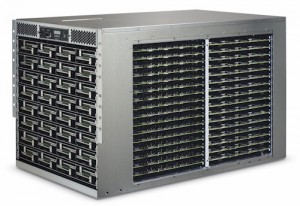
 SeaMicro, a four year old start-up that develops servers designed for web companies that need to perform smaller loads for reduced power costs, released the third generation of its offering. The update comes just a few months after the previous version was debuted. This time, SeaMicro managed to increase computing power by 50 percent while reducing power consumption by 25 percent. Further, the product now features 768 cores compared to the previous two 512-core generations.
Typically server development is a process that would go on for months or years, but SeaMicro set out to greatly reduce that time, and consequently make its offerings much more relevant to today’s market. This is especially true for web companies, the start-up’s key audience, that see demand and workloads growing. Andrew Feldman, the company’s chief executive, explained how SeaMicro achieved this rate.
“Feldman credits the startup’s ability to move quickly with the specialty chip inside SeaMicro’s box that controls how the servers talk to one another. Those specialty networking chips are CPU-agnostic, meaning they could work with any chip, be it an x86 chip from Intel or AMD or a specialty chip from a company such as Tilera.”
This also lets the company offer a 1.28 Terabit fabric, improving how the processors communicate on and inside the motherboard. SeaMicro’s existing customers include Mozilla and eHarmony, among others.
The startup is aiming to gain as maker of a cost-efficient datacenter components, but it’s not the only product out there that puts an emphasis on this area. Veridity’s EnergyCenter 2.0, a software offering that aims to simplify the measurement of datacenter power consumption, is another example.
In other recent datacenter news, Microsoft, which is currently developing its consumer front, Dell, and others will be subject to some scrutiny from residents of Quincy, Washington, a major datacenter hub for a number of tech companies. Having green tech is an important consideration for datacenters, as their presence can ultimately affect the surrounding environments. Companies like SeaMicro hope to make datacenters greener, and more efficient. Meanwhile several thousand miles away, IBM is building two new datacenters in Japan to power its Lotus Live and SmartCloud services.
Support our mission to keep content open and free by engaging with theCUBE community. Join theCUBE’s Alumni Trust Network, where technology leaders connect, share intelligence and create opportunities.
Founded by tech visionaries John Furrier and Dave Vellante, SiliconANGLE Media has built a dynamic ecosystem of industry-leading digital media brands that reach 15+ million elite tech professionals. Our new proprietary theCUBE AI Video Cloud is breaking ground in audience interaction, leveraging theCUBEai.com neural network to help technology companies make data-driven decisions and stay at the forefront of industry conversations.




