






If your organization uses social media for customer support purposes, I hope you’ve got all the kinks worked out of your system and processes. That’s because failed social media customer interactions can result in significant costs.
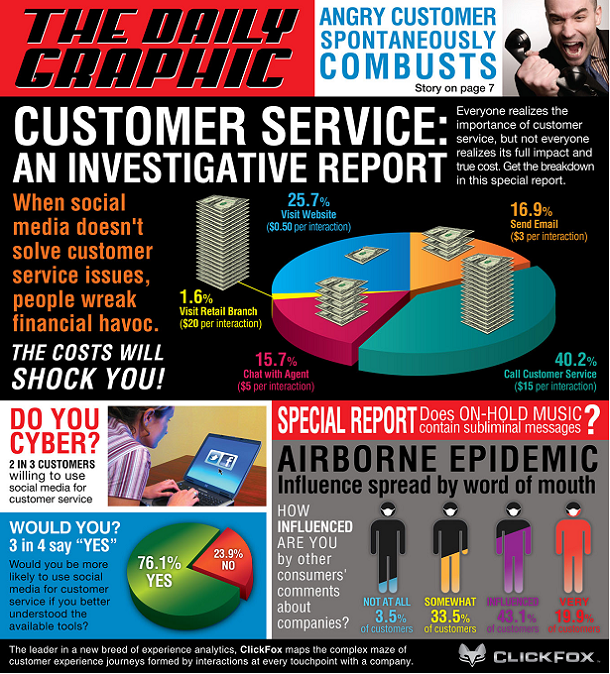
Each time a social media interaction fails to resolve a customer support issue, that customer must resort to another touch-point with your company. Research by Clickfox as illustrated in a new infographic breaks down what customers do after a failed social media interaction and just how much each subsequent customer interaction costs on average.

What does this all mean? It means you better perfect your social media customer service program or be prepared to pay through the nose when it breaks down.
Big Data plays an important role here. In order to rectify failed interactions, you have to understand both why a social media customer interaction broke down and when in the larger customer experience lifecycle the interaction broke down. If you only have one or the other of these data points, the likelihood of solving the root issue goes down.
The why is the more obvious of the two points. If a customer bails on a social media support interaction because they didn’t receive a timely response, for example, obviously you need to improve response times.
But the when element is also a crucial because such data can indicate that the real breakdown occurred somewhere else in the customer experience lifecycle.
For example, let’s say a customer becomes frustrated after several failed Facebook customer support interactions. Then let’s say the customer complains about the interaction on Twitter, prompting a direct Tweet by support staff to the customer. But the customer has become so exasperated that he or she ignores your support staff’s Tweet and picks up the phone (costing you $15 per call per customer!)
In the above example, was it the Facebook interactions or the Twitter interactions that caused the customer support failure? I’d argue it was the Facebook interactions — and that’s where you need to improve your service. The only way to understand this kind of insight is to apply customer experience analytics to all your customer support touch-point data, including social media. By understanding when in the support process customers become frustrated, you can better target areas for improvement.
Combine the two – the when and the why a customer support social media interaction failed – and you’ve got the best chance at getting to the root of the problem.
Support our mission to keep content open and free by engaging with theCUBE community. Join theCUBE’s Alumni Trust Network, where technology leaders connect, share intelligence and create opportunities.
Founded by tech visionaries John Furrier and Dave Vellante, SiliconANGLE Media has built a dynamic ecosystem of industry-leading digital media brands that reach 15+ million elite tech professionals. Our new proprietary theCUBE AI Video Cloud is breaking ground in audience interaction, leveraging theCUBEai.com neural network to help technology companies make data-driven decisions and stay at the forefront of industry conversations.





