







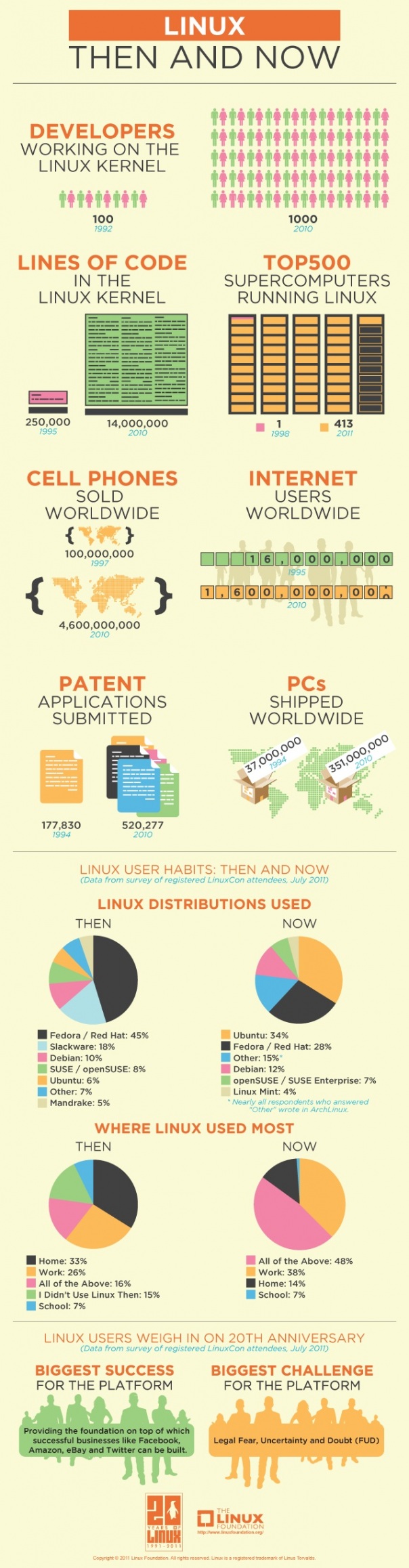
 Open-source is becoming a huge trend in the cloud and beyond, just as one of the original proponents of open-source turns 20. Linux has grown immensely since it was first conceived two decades ago, an essential era that was depicted in an infographic the organization recently released. The figures are all based on a poll conducted during LinuxCon 2011.
Today, there are about 10 times more developers working on Linux Kernel than the 100 individuals that were doing the same in 1992. There’s a reason behind that, considering the OS ballooned from just 250,000 lines of code then to the 14,000,00 lines the latest version packs now.
When looking at usage patterns, some trends stand out above others. Thirty three percent of respondents used Linux-powered computers at home 20 years ago compared to only 14 percent now. More interestingly, 48 percent of respondents said they were using Linux at school and home, compared to only 16 percent in the ‘90’s.
Linux is expanding as the open source trend grows, but its impact far outweighs its userbase, according Red Hat CEO Jim Whitehurst. Citing, among other things, the original Google, Backrub.Stanford.edu, was built on Linux, and that Facebook leverages the OS today, Whitehurst gave a lot of credit to the platform.
“The power of innovation that Linux [enables] from a business perspective is hallmark about what open source has done for Web 2.0,” he noted. “Web 2.0 would not exist in its current form if it weren’t for the business model of Linux.”
Speaking of open-source business models, Red Hat had a significant update this week . It rolled out its Enterprise Virtualization 3.0 hypervisors into beta, partially as a part of an attempt to bank on VMware customers looking at more affordable alternatives in light of a recent price hike. VMware in turn has been working on an open-source intiative of its own – Cloud Foundary, that received a major boost this week as well.
Support our mission to keep content open and free by engaging with theCUBE community. Join theCUBE’s Alumni Trust Network, where technology leaders connect, share intelligence and create opportunities.
Founded by tech visionaries John Furrier and Dave Vellante, SiliconANGLE Media has built a dynamic ecosystem of industry-leading digital media brands that reach 15+ million elite tech professionals. Our new proprietary theCUBE AI Video Cloud is breaking ground in audience interaction, leveraging theCUBEai.com neural network to help technology companies make data-driven decisions and stay at the forefront of industry conversations.




