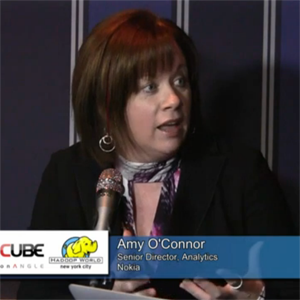







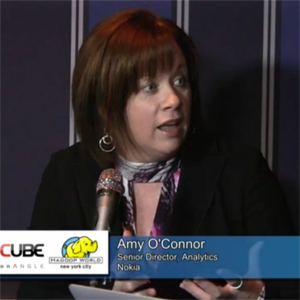
 The troubles facing smartphone manufacturer Nokia have been front and center a lot lately so seeing them at Hadoop World 2011 shines a light on their future intent. Nokia Senior Director of Analytics, Amy O’Connor, came into theCube for an interview with John Furrier and Dave Vellante about how Nokia is using Hadoop and unstructured data to provide data services for their customers. The discussion ran from the gathering of information from customers, some about privacy and anonymization, and most importantly how the cellphone maker intends to use big data solutions such as Hadoop to build and guide their infrastructure decisions.
O’Connor says that Nokia really has two businesses coming together: the mobile phone business and their location-based business. Much of the location-based setups for Yelp, Yahoo!, others happen to be based on Nokia’s maps. The first phase was to allow phones to go mobile, the second phase was making computers go mobile, and the third phase has been to congeal data and physical presence: straight-up augmented reality.
The phones that Nokia produces collect a great deal of data from sensors in the phone, from customer relationships, from how they’re used, and how they interact with the network and one another. As a result, Nokia might be a company who manufactures phones; but they produce a lot of data as exhaust. That means that the smartphone maker has a huge amount of product that they need to then manage.
The data challenges that Nokia faces with respect to data happen to be myriad, but the biggest one has always been privacy. “We’ve traditionally been a company who have leaned towards the side of anonymized data and privacy,” O’Connor told John Furrier. “And we’re a global company…that means it’s the biggest, biggest concern that we have.”
While the Nokia Senior Director wanted everyone to know that privacy is a huge concern and direction for the phone maker, John wanted to know more about how they used Hadoop to perform solutions for all the data they’re gathering.
Nokia is currently running a Hadoop system. Since each division faced a great deal of data challenges people started to begin pulling from the open source community and decided to centralize a bunch of Hadoop solutions. They decided to make one-big-shift and centralize their data analysis division; but they intended to do it with a hub and spokes. The beating heart of analysis at Nokia happens to be a Hadoop system, but it feeds satellite projects and analysis who can take the data and transform it from that point.
Many of the cellphone maker’s products happen to be consumer apps. These apps are enabled via data, they consume, transform, and manufacture data and all of that needs to move through the infrastructure. As a result, Nokia felt that the centralized aspect of using Hadoop a the center as a command and control and data warehouse center would give them the most agile setup for scaling and bringing data to their customers.
“Technology keeps changing, and I’ve been in the industry a long time, and it keeps changing and if we don’t get in front of that, we’ll fall behind and someone else will take over,” O’Connor said. “We have a 120 terabyte warehouse in Teradata…” Instead of pushing further data into that Teradata warehouse that just won’t fit or would overwhelm the data scientists—or worse runs on unstructured data—Nokia has sought to put it through Hadoop so that it could be transformed and brought back in again.
Support our mission to keep content open and free by engaging with theCUBE community. Join theCUBE’s Alumni Trust Network, where technology leaders connect, share intelligence and create opportunities.
Founded by tech visionaries John Furrier and Dave Vellante, SiliconANGLE Media has built a dynamic ecosystem of industry-leading digital media brands that reach 15+ million elite tech professionals. Our new proprietary theCUBE AI Video Cloud is breaking ground in audience interaction, leveraging theCUBEai.com neural network to help technology companies make data-driven decisions and stay at the forefront of industry conversations.





