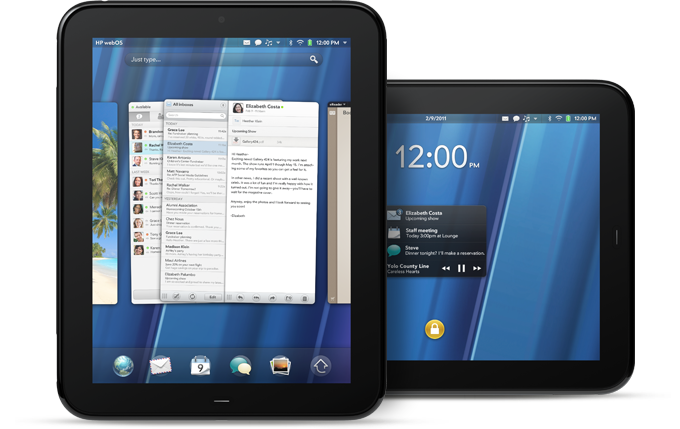







 One major missing piece from last week’s webOS announcement is any hint of what HP itself might do with webOS. HP does promise continued support, which might mean that it will rehire the recently laid-off webOS development team. That would certainly be good news both for those individuals and for the future of the technology itself. However, if HP is going to make further investments in webOS, the question is, why. What use does HP have for it?
HP could revive its webOS consumer tablet line, of course, but consumer tablets are clearly not its market for several reasons. Similarly, HP is unlikely to expand the low-end smartphone line it bought with Palm Inc. – actually it is more likely to sell it. HP has never been interested in smartphones.
However, a webOS tablet for business could be a winner for HP. Many businesses, particularly large enterprises, are not particularly happy with using Android and iOS tablets in large part out of security concerns. They do not want Google or Apple in the middle between them and their mobile employees, either as distributors of business apps through their app stores or in particular as monitors of their internal business activities. The idea that Google, Apple, or particular mobile carriers may be capturing data on what their employees are doing online, and especially internally on the corporate network, is certainly a concern for CIOs and their senior management. And many of those companies are already HP customers.
But before HP can succeed with a webOS tablet, it needs to solve a larger problem. It needs a clear, overall strategy that encompasses all its major divisions and that defines a clear place for mobile computing as part of the overall picture. And it has to make a basic decision on its mobile platform – Windows or webOS. A fragmented approach to this market is a disaster. And if it is going with webOS, then it needs to rebuild its development team and convince third-party vendors, and particularly major enterprise software providers, to support this platform. No matter how good webOS itself is as a technology, companies are not going to buy it unless it can support business functionality, which means working with their core applications.
Donating webOS to Open Source actually is a good first move toward doing this. It allows HP to recruit other hardware players – for instance RIM, Dell, Lenovo and Fujitsu – to the webOS camp by guaranteeing that it will not have control or advantage over them. That would provide it with powerful allies when trying to talk the software vendors into investing in a platform which, at the moment, has no users.
The advantage for these players is that webOS is here today, while the alternative, Microsoft Windows 8, is still just a promise. And of course the price is right. The disadvantage is that by shifting to webOS they will create a rift with Microsoft, which they still need for their desktop and laptop markets. And while Windows 8 is still in development, one thing they know is that it will have full support from the business software community out of the box.
HP also might use webOS as an embedded OS in printers and other products that require a strong link to the network. It’s commercial printing division might be interested in using it in HP’s digital printers to support Web-to-print, allowing the customers of commercial printers to send their print jobs directly to the printer’s shop floor over the Internet. This is the next big thing in that market.
Whatever HP decides, it has to have a strong strategy not just for its tablets but for the entire company. It cannot just throw webOS and Windows tablets into the market with no clear idea of what to do with them and little if any marketing behind them, its “strategy” for the first half of 2011. That is a recipe for failure.
Support our mission to keep content open and free by engaging with theCUBE community. Join theCUBE’s Alumni Trust Network, where technology leaders connect, share intelligence and create opportunities.
Founded by tech visionaries John Furrier and Dave Vellante, SiliconANGLE Media has built a dynamic ecosystem of industry-leading digital media brands that reach 15+ million elite tech professionals. Our new proprietary theCUBE AI Video Cloud is breaking ground in audience interaction, leveraging theCUBEai.com neural network to help technology companies make data-driven decisions and stay at the forefront of industry conversations.





