







 HP will transform webOS into a platform with the goal of creating a world-class HTML5-browser that would potentially compete more with Chrome and Safari than Android or iOS.
The strategy would put HP on a path to potentially extend Enyo and reach into the device market that may include printers and the broader Internet of Things universe.
The vision for the soon to be open sourced webOS came in two interviews I did today with HP senior executives who asked not to be identified.
One of them described webOS as a “platform” rather than an “operating system.” The operating system is actually Linux. Some have suggested that the webOS team should build an Android compatibility layer on top of webOS, but it sounds like HP could be taking the opposite approach.
“Our goal is to create the best HTML5-based browser on the market,” one senior executive said. This recalls HP’s plans to put webOS on Windows desktops, and taken together with the open sourcing of Enyo suggests that webOS might actually be more in competition with Chrome, Safari, Appcelerator Titanium and PhoneGap than with Android or iOS. Representatives from HP didn’t say whether webOS would be made available as an application that runs on top of Android or iOS, but it’s an intriguing possibility.
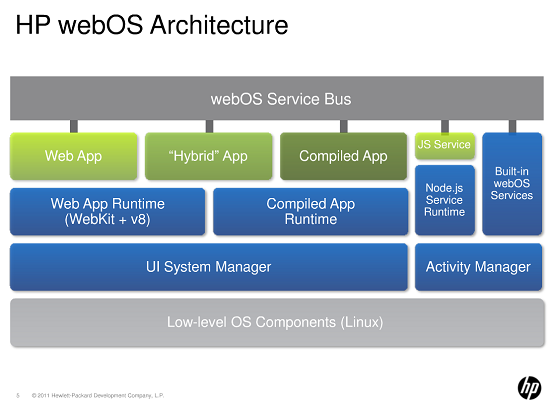
Details of webOS’ architecture from this slide deck
It’s also possible that Enyo is the real play here, and that webOS itself (and its critically acclaimed user interface) will become less relevant. Enyo apps can theoretically run in any WebKit browser, but the license for Enyo forbids using it for anything other than webOS apps. It sounds like that will change once it’s open sourced. HP has already gotten Enyo apps running on the iPad.
Yet another possibility is a combined approach. HP has talked up the potential of webOS as an operating system for non-PC devices such as printers, and today HP CEO Meg Whiteman stated that HP may continue building webOS tablets. The strategy could be Enyo as a cross-platform development framework, and webOS as an OS for the Internet of Things that can run the same HTML5 apps you run elsewhere.
Either way, the big idea here is that HP is focusing on cross-device development rather than trying to get developers write code for yet another OS. HP is still researching the business side of this, but an app store will likely be end up being one of the ways that HP monetizes the platform.
HP is promising a fully transparent and open development process for webOS and Enyo, not the closed model that Google follows with Android. All the repositories will be public and HP will be managing contributions from the public. One source said that HP will have two different versions of webOS, though – a stable one that’s more tightly controlled and a looser version. He likened it to the way that Red Hat handles Red Hat Enterprise Linux. However, he did make it clear that the “stable” version will also be transparent and accept patches from the community. “HP will control contributions with the community,” he said.
Support our mission to keep content open and free by engaging with theCUBE community. Join theCUBE’s Alumni Trust Network, where technology leaders connect, share intelligence and create opportunities.
Founded by tech visionaries John Furrier and Dave Vellante, SiliconANGLE Media has built a dynamic ecosystem of industry-leading digital media brands that reach 15+ million elite tech professionals. Our new proprietary theCUBE AI Video Cloud is breaking ground in audience interaction, leveraging theCUBEai.com neural network to help technology companies make data-driven decisions and stay at the forefront of industry conversations.





