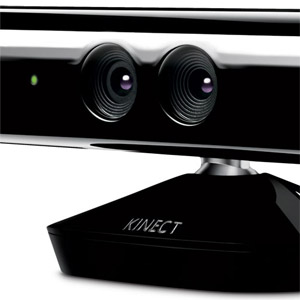







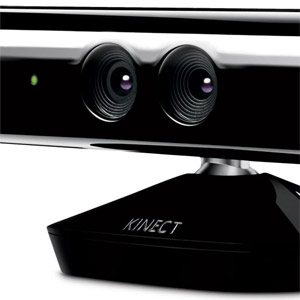
 As a device that “sees” the world, Microsoft’s Kinect peripheral has been providing a lot of potential methods for delivering augmented reality. In this particular demo, Andy Wilson from Microsoft Research shows off the “Beamatron”—a Kinect attached to a motorized pan-tilt armature affixed to a projector (which he says, “You might find one of these in a night club projecting beams of light.) The projector is used to display images on the floor (and potentially walls) using the Kinect to determine how to display the projection so that it appears correctly on the projected surface.
In this sort of augmented reality, instead of augmenting reality seen through a lens like a computer or a cell phone screen, the Kinect is used to make a model of the reality around itself and then project onto it. Because the projector is in a fixed location in the room (on the ceiling) and the light from the projector can strike at odd angles, it will distort any projection cast onto it. As a result, the Kinect 3D modeling software is used to determine how the image must be pre-distorted so that it appears properly formed once cast on the wall/floor/objects.
In the demo, the Kinect 3D modeling also allows him to “drive” an RC car made of projected light around the room. It also behaves as if it were a real RC car when attempting to drive over obstacles. Such as slowing down when it attempts to ascend a ramp, speeding up when going down, and colliding with walls that it couldn’t climb.
The Verge brought this to our attention as well as the video. It’s part of a long line of Microsoft research demos that have been appearing–including a shopping-cart modification for Whole Foods, a robotics expert petting a cat with an Nao robot, among other upcoming projects.
In the demo, since the Kinect camera can see and map the room, it can treat the car and the room as a sort of virtual reality and then adjust the behavior of the car as the user drives it around the room.
Microsoft suggests that this technology might be useful for using ceiling mounted projectors to cast notifications onto walls and surfaces in the line-of-sight of the message recipients. This might be useful in a mall setting, but it would have to be combined with being able to identify the recipient and even determine where they’re currently looking—but the part where the Kinect allows the projector to pre-distort the projected message would mean that even English words would be readable at long distances (rather than stretched out beyond readability.)
I look at the demo and wonder if the next step is to have multiple pan-tilt projectors and Kinect assemblies in the room as to get a much higher fidelity 3D model of the room (after all, the Kinect can only “guess” at what the other side of objects looks like.)
Support our mission to keep content open and free by engaging with theCUBE community. Join theCUBE’s Alumni Trust Network, where technology leaders connect, share intelligence and create opportunities.
Founded by tech visionaries John Furrier and Dave Vellante, SiliconANGLE Media has built a dynamic ecosystem of industry-leading digital media brands that reach 15+ million elite tech professionals. Our new proprietary theCUBE AI Video Cloud is breaking ground in audience interaction, leveraging theCUBEai.com neural network to help technology companies make data-driven decisions and stay at the forefront of industry conversations.





