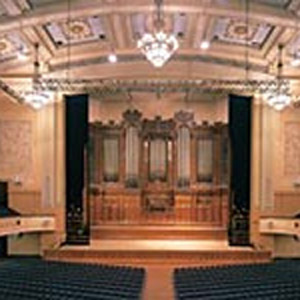







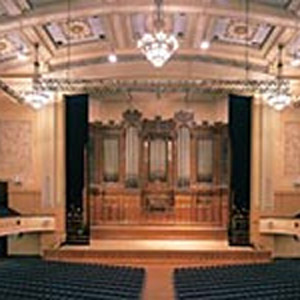
 Melbourne, Australia is the home of an extravagant and beautiful four-story high pipe organ called the Town Hall Grand Organ—installed in 1872, the organ was almost entirely rebuilt in 1905 and still stands today. Originally built and installed by William Hill and Son of London and it took nine months to complete. It is an impressive piece of historic machinery.
Recently, Australian composer Chris Vik desired to play a composition on the historic organ. Interestingly enough, one of the more renovations (post 1905) was the installation of a MIDI controller in the 90s. This enabled him to make use of a Kinect controller to manipulate the grand instrument using Microsoft’s MIDI software.
Vik posted his experience on his blog of setting up and controlling the organ with Kinect. He decided to do a performance of “Carpe Zythum” November 2011 (a snippet of which is seen in the video below.)
“I’ve created my own software Kinectar,” wrote Vik, referring to his own handcrafted performance software, Kinectar, “which allows the use of the Kinect to control MIDI devices, ie. playing notes through simple gestures and motion.”
This experiment and performance is simply yet another example of how gesture-recognition and control can be integrated into almost anything, even an ancient historical instrument. While it’s not as innovative or science fictiony as the development of the Theremin (there’s Kinect software for that) it’s still an interesting way to bring the modern era into touch with the past.
The gesture-oriented mechanism of the Kinect allows it to be used in situations where we might not want people touching a particular thing; but would like to give them some sort of interactivity. The mention of historical objects (even those still in use) brings to light museums and other edifices of education. A Kinect controller at kiosks or in front of exhibits would be an excellent addition for allowing visitors to interact with a UI and learn more about what they’re looking at than simply reading static text.
Just as Vik didn’t need to touch the organ to play it, visitors could manipulate a model of an ancient artifact, zoom, pan, tilt, etc. and listen to a discussion of the object while looking at the real thing hidng beneath glass.
Meanwhile, thinking bout further implications of gesture-controls and history, enjoy some music.
Support our mission to keep content open and free by engaging with theCUBE community. Join theCUBE’s Alumni Trust Network, where technology leaders connect, share intelligence and create opportunities.
Founded by tech visionaries John Furrier and Dave Vellante, SiliconANGLE Media has built a dynamic ecosystem of industry-leading digital media brands that reach 15+ million elite tech professionals. Our new proprietary theCUBE AI Video Cloud is breaking ground in audience interaction, leveraging theCUBEai.com neural network to help technology companies make data-driven decisions and stay at the forefront of industry conversations.





